“Though I’m a deliberate planner, I create instinctively.”
János Szirtes talks about his works from the 1980s to Barbara Kriesch.
Painting for Pleasure, an exhibition hosted by the Tér-Kép Gallery, maintained by the Budavár Municipality, presents large-format paintings by János Szirtes made between 1985–1990, on loan now from private collections.* This interview looks back at the creative period of the artist around the time of the political regime change.
What kind of a setting did your career start in?
I completed my master’s degree in 1983. Even then, I was already thinking in terms of series and projects. One of my first such works was a set of graphic illustrations created at the request of art historian László Beke. These were published in the 1983 issue of CÁPA – Bölcsész Index, the journal of the Faculty of Humanities at ELTE University. It was a significant moment for me since this was an uncensored periodical, and I was entrusted not only with the cover but the entire set of illustrations. To understand the visual language of my early period, it's important to note my interest in technical diagrams – such as the forms of fighter jets, which I interpreted as dragon-like, mythical figures. I sublimated these and similar motifs, blending them with elements from folklore, prehistoric imagery, and visual forms from both ancient and non-European cultures. Growing access to global artistic and cultural heritage – through technology, communication, and loosening borders – played a key role in this process. I was especially influenced by ancient South American cultures: their statues, carvings, masks, and paintings. A Hungarian reference point was also present in my childhood, Dezső Malonyai’s ethnographic volumes, rich in folk motifs from across the Carpathian Basin, were part of our family library. I merged these influences into my own visual system.
How did your background in graphics mark this era?
As a graphic artist, I’ve always been interested in layering – how to superimpose visual strata on a two-dimensional surface in such a way that the underlying image doesn’t disappear, but continues to live in the background, while sharper, more expressive layers emerge above. One of my memorable series from the 1980s is the set of Göbzi works, based on the transformation of fighter planes into dragon-like forms. I painted over furniture brocade fabric using acrylic and textile paint. I introduced my instinctive script, spontaneous, internal gestures that allowed me to build a graphic system on these shimmering, silvery surfaces. These compositions were often tense, evoking flight formations. The markings or “writings” that appear on the surface are ones I can still “read”, they remind me of what I was listening to, feeling, and experiencing while making the piece.
In what way did your performer profile contribute to this?
Though I am (also) a performer, visual creation remains a fundamental part of my life. Painting brings me pleasure, and I always hope that the energy of that joy can be transferred to the viewer. Yet, when I finished my studies, I still felt unfinished. That’s when I began to explore ethnographic and prehistoric symbols more deeply. I spent time in museums and even zoos copying and drawing, but eventually began asking myself: Why am I copying these things? Where am I in this? Where are my roots? That led me to begin developing my own system. I wasn’t looking for figurative representation, I was looking for dynamism, for energy. And that’s still what I seek today.
What is the role of the body in painting?
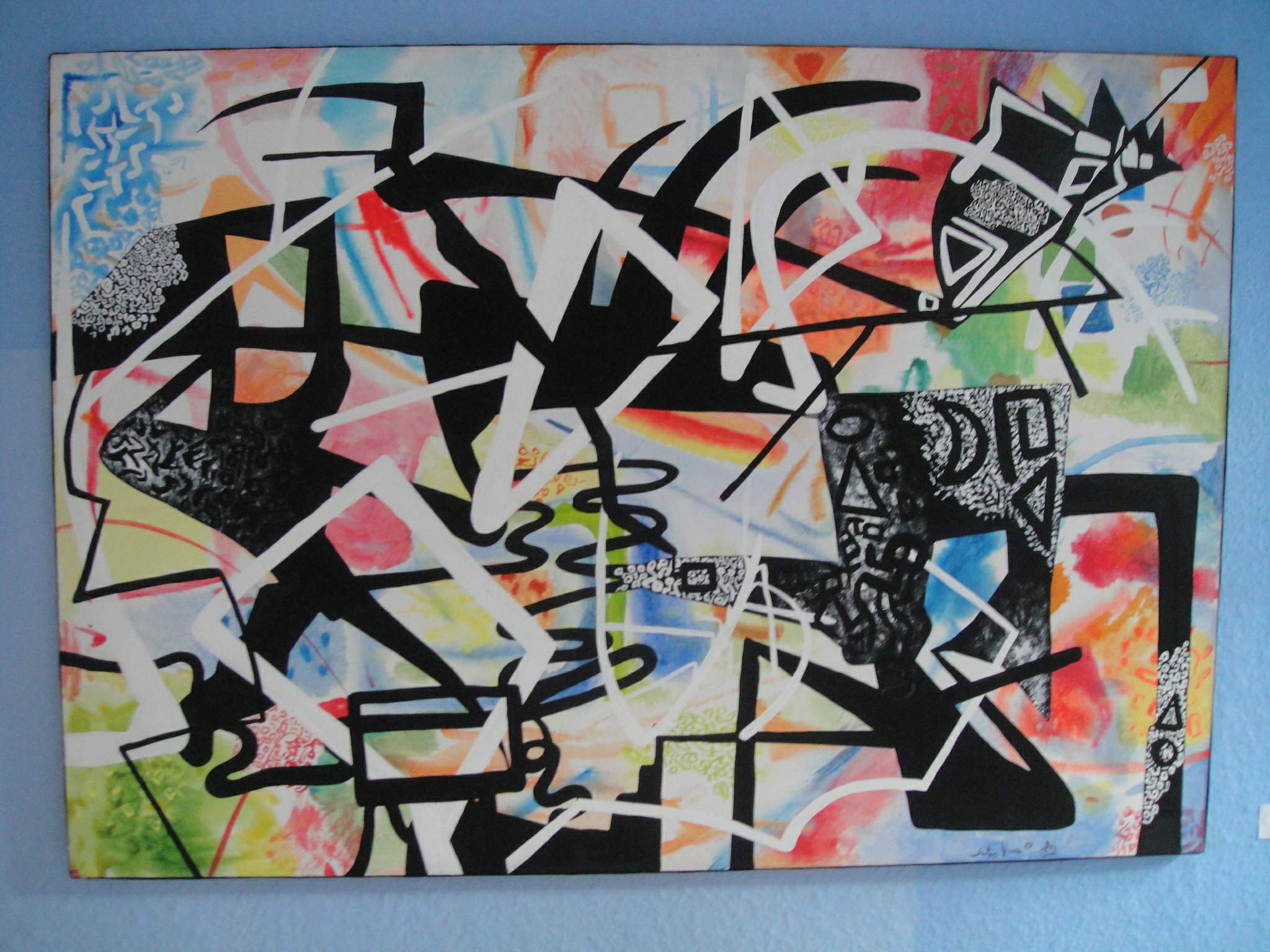
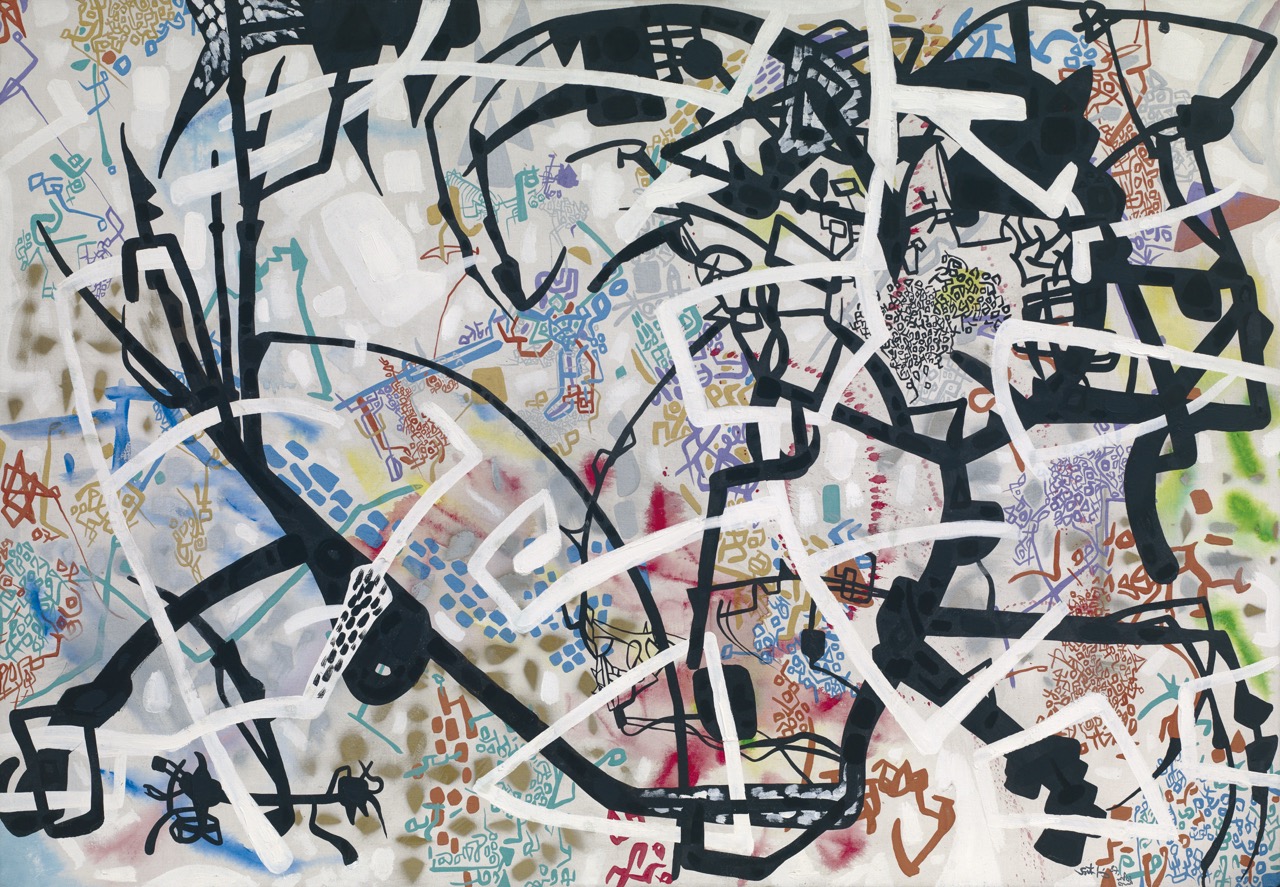
I work with gestures. As a teacher, I also consider this essential. A gesture leaves a trace. When I dance, I leave a mark; when I move, I carve out situations. My mother was a music teacher, and the first thing she taught her students was how to relax their wrists. The line is different if drawn from a fingertip, from the wrist, or from the entire arm. These movements, these gestures leave traces, and I believe they also transmit energy. This is illustrated well by my painting Widow, created in 1988, which also draws on collected ethnographic and ancient motifs, and by this point, I had internalized them. The background features a watercolour-like, colourful puzzle structure, out of which white motifs emerge as sources of visual energy. Two main forms appear, abstracted humanoid figures. The title Widow reflects the emotional tone I associate with the work. I don’t want viewers to see anything “specific” in it. It doesn’t resemble anything. It simply is what it is.
The key work of the current exhibition draws on its golden background. What was your inspiration for this?
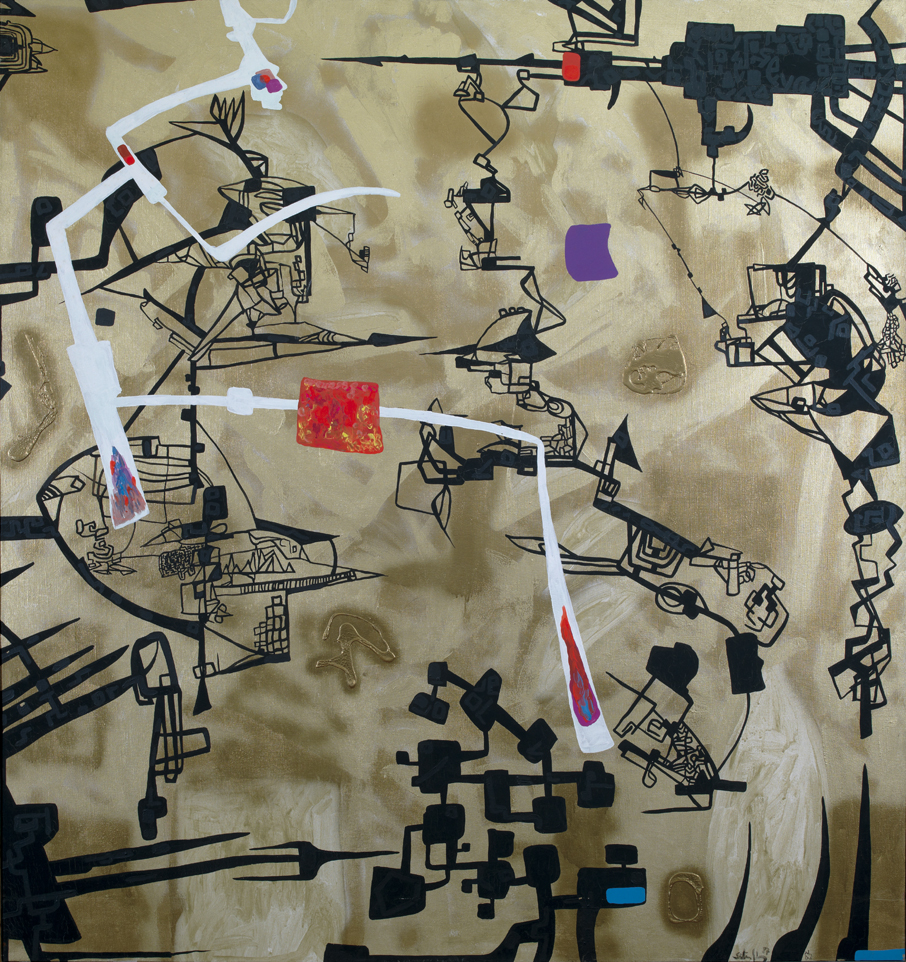
Wisecrack was the first piece in a new series. Here, free association is encouraged. Two entities seem to split into multiple parts. This was the moment I first started working with gold. I’ve always been drawn to the timelessness of gold, particularly in Orthodox icons, how they bear the weight of centuries; and gold remains eternal, not just for its noble lustre but for its ethereal, sacred presence. Today, I use lacquer-based paints containing gold powder, but in this piece, I hadn’t yet adopted that technique. Instead, I experimented: I used Technocol Rapid and lacquer spray to create a shimmering surface, which has held its brilliance over time. This brought out the relationship between layers, their closeness and distance. A white entity completes the composition. Five or six layers are visible, often overlapping within a shared space. To me, this reflects human interaction: in communication, I too must filter, concentrate, just as in dance, where I either find balance or enter a harmonious or dissonant dynamic.
Yet the closing work of the present show fewer layers only.
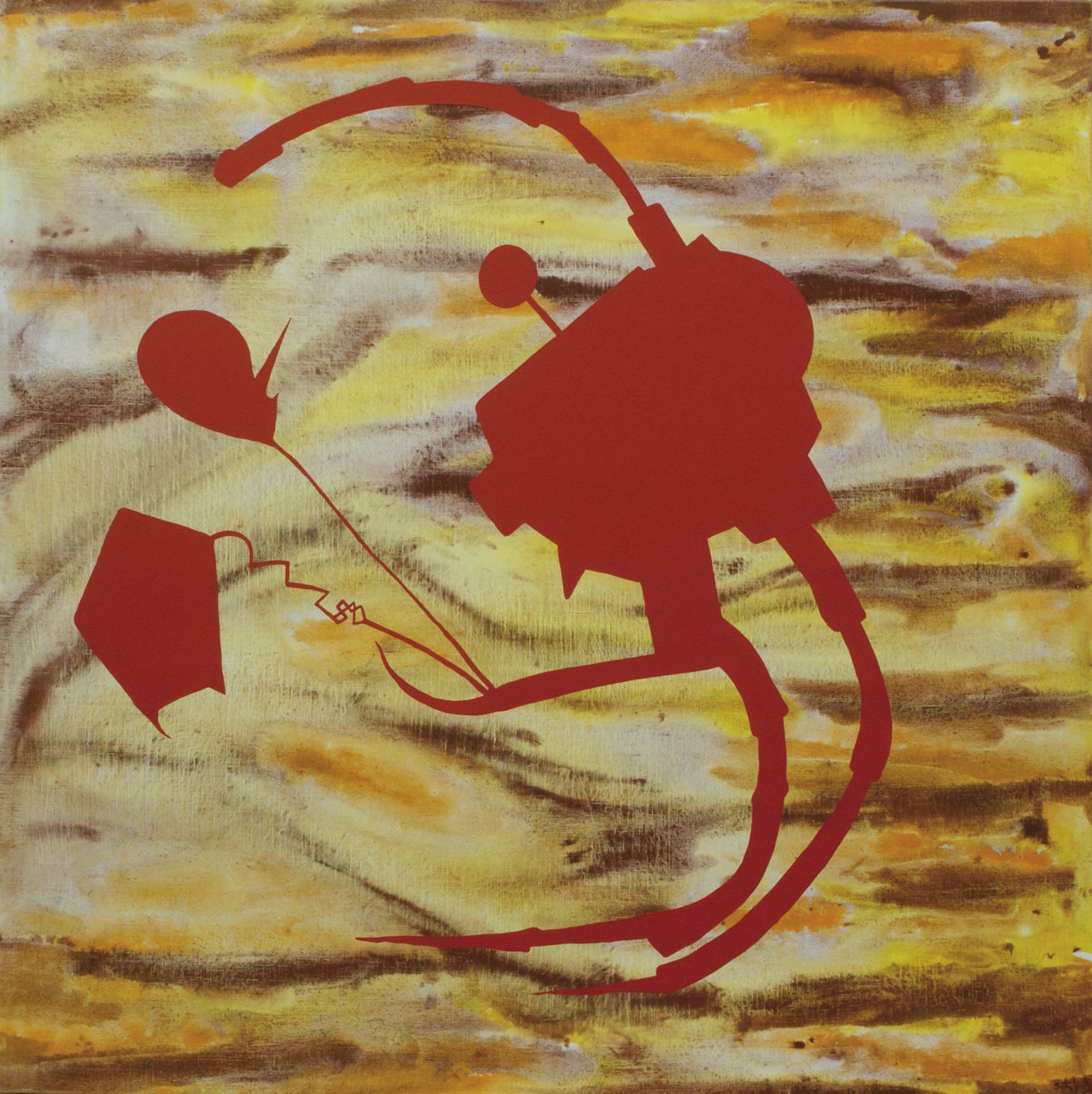
Batthyány I was painted in my District I studio where I moved in 1990. It’s a looser composition, centred within the frame. The background features a washed base, over which a single, enclosing entity appears. In this series, I didn’t need multiple layers, the idea I wanted to express was already present. Though I’m a deliberate planner, I create instinctively. There are always studies, but when I face a blank canvas, I never decide every detail in advance. My use of colour is always a direct reflection of my emotional state. That’s what I believe in, that’s how I express the mood of the moment.
The specificity of this exhibition is that it rests on loans from private collections. How do you relate to collectors?
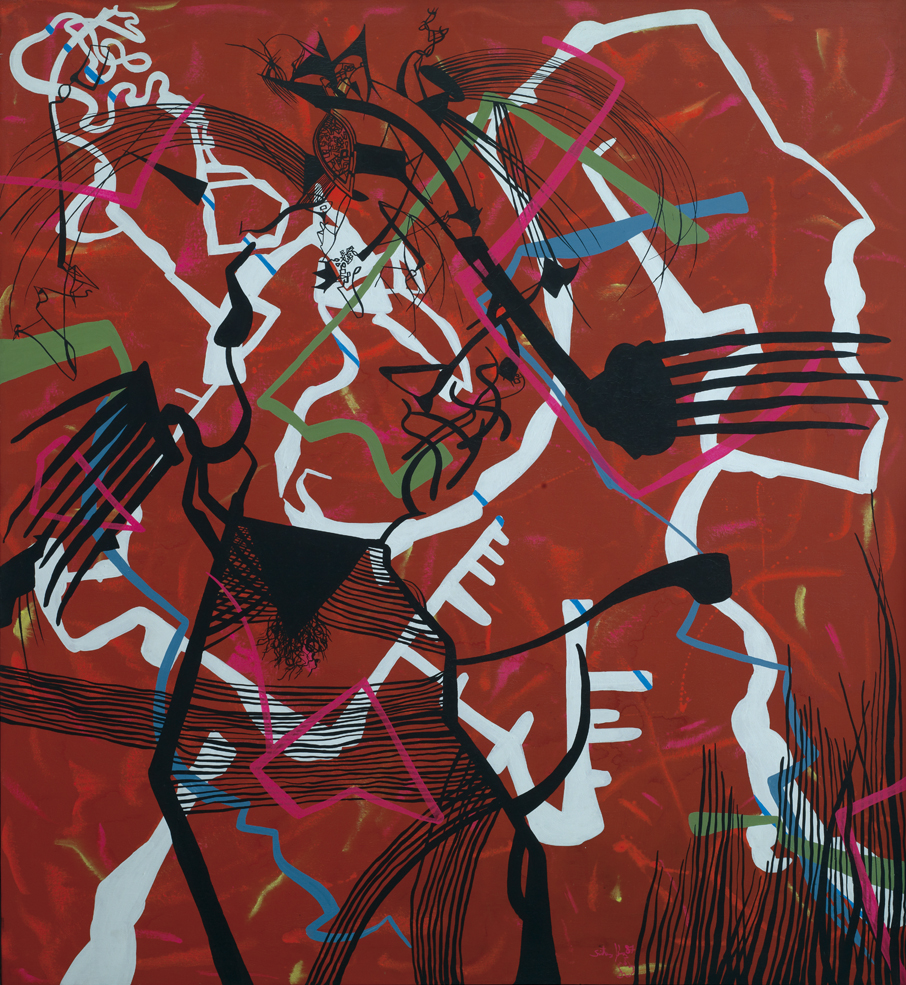
Perhaps it’s exactly this emotional stance towards my own art why I formed such close, personal connections with some collectors. One great example is Péter Szép, who sadly passed away ten years ago. He appreciated my work, which led to honest conversations, and over time, a true friendship. Like a dedicated wine collector, he would select one piece from me each year. His collection eventually came to include perhaps the largest number of my works. He had a real collector’s passion, paired with a businessman’s integrity. He stayed with the artists he collected throughout different stages of their careers. He also acquired Jung, which today belongs to László Zimányi’s collection. In that painting, multiple perspectives are present, there is no dominant horizontal view. One layer always shifts to the next. That’s the essence of composition. In this case, a central black structure closes inward and forms an upward movement towards right.
Where did all the energy that pulsates in your works come from?
This was the time before I began teaching, and I devoted most of my time to creation. The painting Mohamed testifies to this a highly productive period in my life. The title might seem striking: I never decide titles in advance. I begin without one, though that doesn’t mean I start without a theme. The theme always lies in the method, the dynamics, the layered system I’ve developed over the years. I tweak this approach constantly, but it forms the core of my practice. Mohamed is a self-contained composition, living within its borders. In the background, free and instinctive script elements already appear, and move into the black surface layer. Over this, I applied white instinctive gestures, creating a carpet-like effect. These may resemble organic or geometric forms. Then I painted over parts with black again, giving the work its particular rhythm. That re-painting process was the innovation in this series: washed background, black overlay, white script, then black again. In Montezuma, the calligraphic elements become even more pronounced. Still, the composition is dominated by a large, black, enclosed form, within which the white layer becomes interwoven. Here too, it was the visual tension and colour effect that interested me. In that sense, I might even call myself a colourist.
During these years, were you also working in media other than painting?
I was also producing graphic series. One of my earliest collectors, Gábor Hunya was drawn to my art first through my graphic work. He recognized a kind of intellectual freedom in what I was doing. That graphic series grew into one of the largest I’ve made. I came across a batch of small, landscape-format frames by chance, formats that appealed to collectors. Until then, I had mostly worked on larger paintings, where the physical gesture of the arm could really come through. In drawing, however, a 70x100 cm sheet is considered large. With works on paper, I returned to this more domestic scale, one suited for display in a home. Small formats have their advantages: they’re intimate, even giftable. I enjoyed creating that series and discovered that my spontaneous writing system worked well even in smaller formats.
János Szirtes: Painting for Pleasure,
Tér-Kép Gallery, Budapest
On view until 6 September.
Photos: Várfok Gallery
